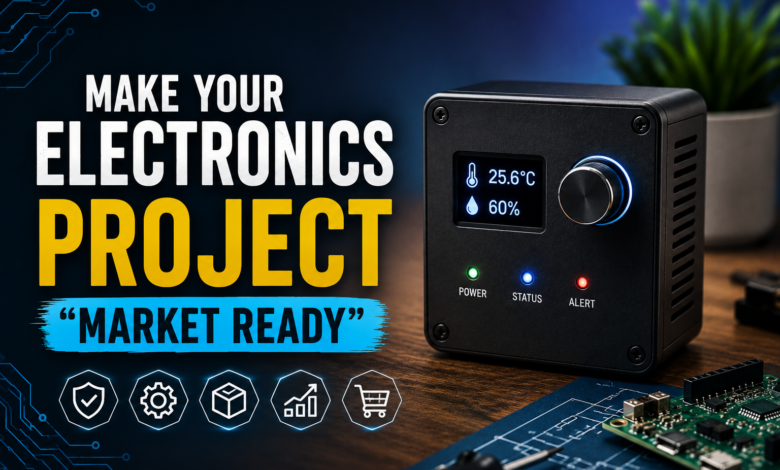
Making an electronics project “market ready” means turning your cool prototype into something reliable, safe, repeatable, and desirable enough that people will actually pay for it. It’s not just about the circuit working once on your desk—it’s about buildability, user experience, cost, certifications, and support.
Prove the concept, then simplify
- First, get a solid proof‑of‑concept working on dev boards, modules, and jumper wires. Focus on solving a real problem, not adding features.
- Once it works, simplify ruthlessly. Remove non‑essential features, combine functions, and choose parts that are easy to source and well supported.
This step keeps your BOM cost under control and reduces future bugs.
Design for manufacturing (DFM) early
- Move from breadboard to a proper PCB, keeping manufacturing in mind: clear silkscreen, test points, standard footprints, and minimal part variety.
- Use components that are in active production, available from multiple vendors, and suitable for automated assembly.
Good DFM means your product can be built in volume without constant redesigns.
Build, test, and iterate prototypes
- Create several PCB revisions: first for function, then for reliability and manufacturability.
- Stress test: over‑voltage, reverse polarity, temperature, ESD, and long‑term running. Collect real user feedback on usability, enclosure, connectors, and documentation.
Aim to uncover and fix failures before paying for a big production run.
Think enclosure, UX, and documentation
- Design an enclosure that’s robust, easy to assemble, and looks like a finished product, not a student project. Consider mounting holes, cable routing, and ventilation.
- Provide clear labels, status LEDs, connectors that are hard to plug in wrong, and a simple quick‑start guide or QR link to documentation.
A good user experience is a big part of “market ready.”
Plan for compliance and safety
- Identify what certifications apply in your target markets (EMI/EMC like FCC/CE, safety standards, sometimes wireless approvals).
- Design with these in mind: proper grounding, creepage/clearance, shielding, and using certified modules for WiFi/Bluetooth when possible to reduce cost and effort.
Skipping this step can block you from selling legally.
Costing, suppliers, and small production run
- Build a detailed bill of materials (BOM) with multiple suppliers and real prices, including assembly and enclosure costs.
- Do a small pilot run (e.g., 20–100 units) with your chosen manufacturer to verify yield, quality, packaging, and test procedures before scaling up.
Use this batch to test your order, shipping, and support processes with real customers.
Tinku 🤖 :
This is all about How to Make Your Electronics Project “Market Ready”, Visit Tinkercircuits.com for more exciting blogs!
Happy Tinkering! The Tinker Circuits Team