Voltage, current, and resistance are the three basic “ingredients” of any circuit, and they are tied together by Ohm’s law, which says V=I×R. Understanding them with simple real-life comparisons makes the math much easier to remember.
What is voltage?
- Voltage is the “electrical pressure” that pushes charges through a circuit, measured in volts (V).
- A good analogy is water pressure in a tank pushing water through a pipe: more pressure means water “wants” to flow more strongly.
Real example
- A 9 V battery has more “push” than a 1.5 V AA cell, so it can drive more current through the same resistor or LED.
What is current?
- Current is the rate at which electric charge flows, measured in amperes (A).
- In the water analogy, current is like the amount of water flowing per second through a pipe.
Real example
- If an LED datasheet says it needs 10 mA, that means the LED wants 0.01 A of current for normal brightness.
What is resistance?
- Resistance tells how much a component opposes current, measured in ohms (Ω).
- In the water analogy, resistance is like a narrow section of pipe that makes it harder for water to flow.
Real example
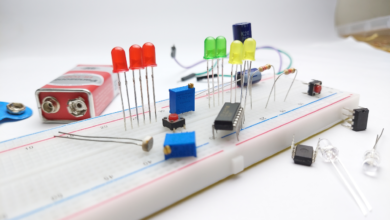
- A resistor in series with an LED limits current so the LED does not burn out; a higher resistance value means less current.
How they work together (Ohm’s law)
Ohm’s law links them
- V=I×R
- I=V/R
- R=V/I
Real LED example
- You have a 9 V battery and an LED that drops about 2 V at 10 mA. The resistor must drop the remaining 7 V at 0.01 A, so R=7/0.01=700 ΩR=7/0.01=700 Ω (you’d pick the nearest standard value, like 680 Ω or 720 Ω).
Everyday-style examples
- Mobile charger
- The adapter output is something like 5 V or 9 V; that’s the voltage.
- The “2 A” or “3 A” rating is the maximum current it can safely supply.
- The phone’s internal circuits and components provide resistance that sets how much current actually flows at that voltage.
- Room light with a dimmer
- Mains voltage is nearly fixed, but a dimmer effectively changes the resistance or effective path so less current flows, making the bulb dimmer.
- Long thin wires on a PCB
- A long, thin trace has higher resistance than a short, wide one, so it causes more voltage drop when high current flows through it.
- That is why power traces on PCBs are made wider to keep resistance (and heat) low.
This is all about Understanding Voltage, Current, and Resistance, Thanks for reading.
Check out my other articles.