If you’re starting your journey in electronics, one of the first things you need to understand is the basic building blocks of every circuit. Whether you’re working on Arduino projects, robotics, IoT, or simple DIY experiments, these components appear everywhere.
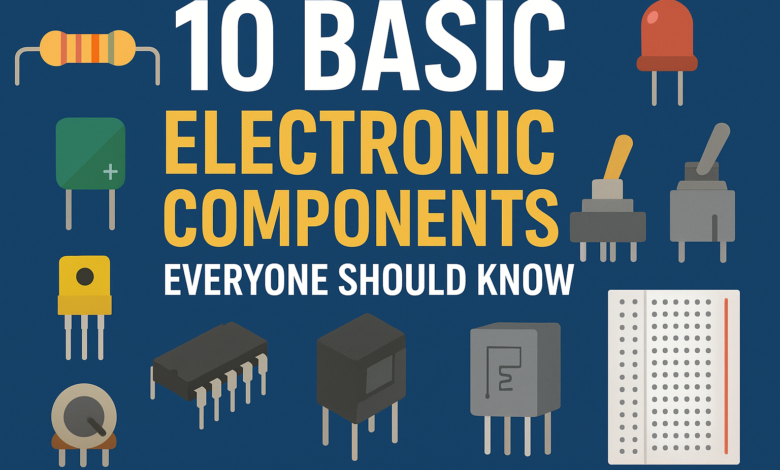
In this blog, we’ll break down the 10 most essential electronic components—what they do, why they matter, and where you’ll commonly use them.
1. Resistors
Resistors limit the flow of electrical current.
They protect components like LEDs from burning out.
Common uses
- LED current limiting
- Voltage dividers
- Pull-up/pull-down circuits
2. Capacitors
Capacitors store and release electrical energy.
They smooth voltage, filter noise, and stabilise power supplies.
Common uses
- Power supply filtering
- Timers (with resistors)
- Signal coupling
3. Diodes
Allow current to flow in only one direction.
They prevent reverse current that can damage components.
Common uses
- Protection circuits
- Converting AC to DC
- LED indicators (LEDs are diodes!)
4. LEDs (Light Emitting Diodes)
Convert electrical energy into light.
They serve as visual indicators and appear in nearly all electronics.
Common uses
- Power indicators
- Display panels
- Flashlights & decorations
5. Transistors
Act as electronic switches or amplifiers.
They are the foundation of modern electronics and microcontrollers.
Common uses:
- Motor control
- Signal amplification
- Switching circuits
6. Integrated Circuits (ICs)
Contain multiple miniaturised components (like transistors) in a single chip.
They simplify complex functions such as timers, amplifiers, motor drivers, and microcontrollers.
Popular IC’s
- 555 Timer
- L293D Motor Driver
- ATmega328P (Arduino’s brain)
7. Switches
Manually open or close a circuit.
They allow you to control devices easily.
Common types
- Push button
- Toggle switch
- Slide switch
8. Potentiometers
Variable resistors used to change voltage or resistance manually.
They allow precise control.
Common uses
- Volume knobs
- LCD contrast adjustments
- Sensor tuning
9. Relays
Electrically controlled switches.
They let low-power circuits (like Arduino) control high-power devices (like fans or lights).
Common uses
- Home automation
- Motor control
- Safety circuits
10. Breadboards
Allow temporary, solder-free circuit building.
They make testing and prototyping quick and easy.
Common uses
- Learning electronics
- Trying new circuit ideas
- Arduino connections
Conclusion
Understanding these 10 basic components is the first major step toward mastering electronics. Once you get comfortable with them, you’ll be able to create your own circuits, debug problems, and build exciting projects with confidence.
If you’re just starting out, experiment with these components on a breadboard—it’s the fastest way to learn!
This is all about 10 Basic Electronic Components Everyone Should Know, Thanks for reading.
Check out my other articles.