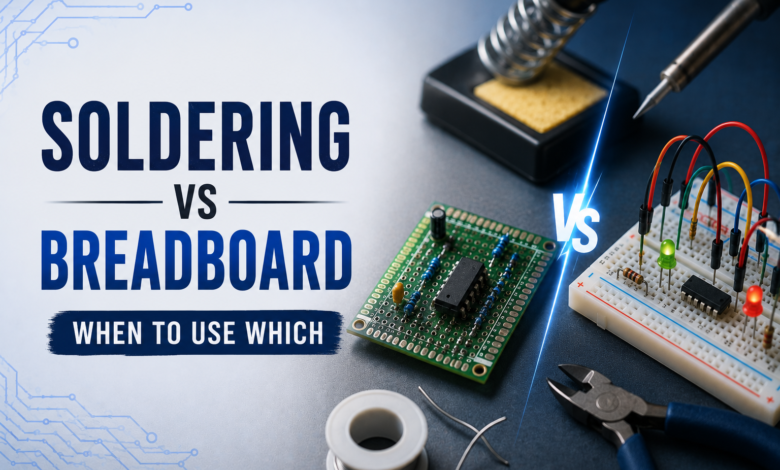
Not sure when to solder a project versus keep it on a breadboard? This beginner-friendly guide breaks down the pros, cons, and best use cases for each method.
Soldering vs Breadboard – When to Use Which :
Every electronics project eventually raises the same question: should this stay on a breadboard, or should it be soldered? Both methods have their place, and picking the wrong one can mean a fragile final build or wasted time soldering something that was only ever meant to be tested. This guide breaks down when each method makes sense.
What Is a Breadboard Good For?
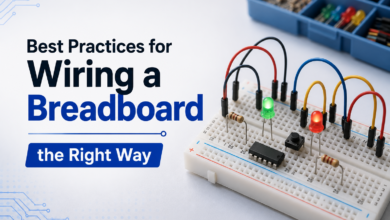
A breadboard lets you build and rewire a circuit without any permanent connections, using pushed-in components and jumper wires. This makes it ideal for prototyping, testing ideas, and making quick changes without committing to anything. If you’re still figuring out whether a circuit works the way you expect, a breadboard is almost always the right starting point.
What Is Soldering Good For?
Soldering creates a permanent, mechanically strong electrical connection, usually on a perfboard, protoboard, or custom PCB. It’s the right choice once a design is finalised and needs to hold up to handling, vibration, or long-term use — situations where a breadboard’s loose connections would eventually work themselves loose or fail.
Key Differences Between Breadboarding and Soldering
| Feature | Breadboard | Soldering |
|---|---|---|
| Permanence | Temporary, easily changed | Permanent |
| Reliability | Prone to loose connections over time | Solid, stable connections |
| Speed to prototype | Very fast | Slower, more deliberate |
| Durability | Poor for movement or long-term use | Good for handling and vibration |
| Reversibility | Fully reversible | Difficult to undo without desoldering |
| Best for | Testing, learning, iterating | Final builds, portable or long-term projects |
When to Use a Breadboard :
- You’re still testing whether a circuit design actually works
- You expect to change component values, like swapping resistors while tuning a circuit
- You’re learning and want to understand a circuit before committing to it
- The project will only exist temporarily, like a one-off demonstration
When to Solder :
- Your circuit design is finalized and tested
- The project needs to be moved, worn, or handled regularly
- You want a permanent build that won’t shift or lose connections over time
- You’re building something meant to last beyond a single afternoon of tinkering
A Practical Example :
If you’re figuring out the right resistor value for an LED circuit, a breadboard lets you swap resistors in seconds until you land on the right brightness. But once that value is confirmed and you’re building a final version to put inside an enclosure or wear as a wearable project, soldering that same circuit onto a perfboard makes it durable enough to survive being handled, moved, or bumped without a connection working loose.
Tips for Beginners :
- Always prototype on a breadboard first, even for a project you’re confident about — it’s much cheaper to fix a mistake before it’s soldered.
- Take a clear photo of your working breadboard layout before moving to solder, so you have a reliable reference while transferring the circuit.
- Practice soldering on scrap components before working on a project you care about, since technique improves quickly with a little practice.
- Perfboard and protoboard are a good middle step between a breadboard and a custom PCB, letting you solder a design without needing to design and order a board.
Frequently Asked Questions :
- Can I leave a project on a breadboard permanently?
It’s possible for low-stakes projects that won’t be moved, but breadboard connections can loosen over time, especially with any handling or vibration, making them unreliable for long-term or portable builds.
- Do I need to know how to solder before using a breadboard?
No. Breadboarding requires no soldering at all, which is exactly why it’s the recommended starting point for beginners before learning to solder.
- What’s a good next step after breadboarding, if I’m not ready for a custom PCB?
Perfboard or protoboard is a great middle ground — it lets you solder a finalised circuit without needing to design or order a custom PCB.
Breadboarding and soldering aren’t competing methods — they’re two stages of the same process. Prototype and test on a breadboard, then solder once the design is confirmed and ready for a permanent, durable build.
Visit tinkercircuits.com for more beginner-friendly Arduino and ESP32 guides.
Happy Tinkering! — The Tinker Circuits Team.