Confused about AC and DC power? This beginner-friendly guide breaks down the difference between alternating and direct current, where each is used, and why it matters for your Arduino and ESP32 projects.
AC vs DC Power – What Beginners Must Know :
Before you plug anything into a breadboard, it helps to understand the two types of electrical current you’ll run into: AC and DC. Every power source you touch — a wall outlet, a battery, a USB cable — delivers one or the other, and mixing them up (or not understanding the difference) is a fast way to damage a component. This guide breaks down what AC and DC actually are, where each shows up, and what it means for your electronics projects.
What Is DC (Direct Current)?
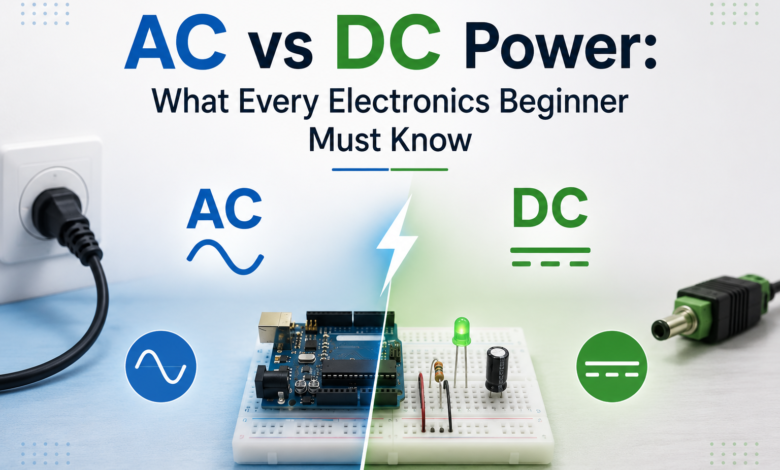
Direct current flows in one steady direction, from positive to negative, without changing. It’s the type of power that batteries, solar panels, and USB ports provide, and it’s what almost every microcontroller — Arduino, ESP32, Raspberry Pi — runs on internally. DC voltage stays constant over time, which is exactly why it’s so much easier to work with in small electronics projects.
What Is AC (Alternating Current)?
Alternating current constantly reverses direction, switching back and forth many times per second. In most countries, the electricity coming out of a wall socket is AC, cycling at either 50 or 60 times per second (50Hz or 60Hz depending on the region). AC is used for power distribution because it can be transmitted over long distances far more efficiently than DC, which is why it’s the standard for household and grid power.
Key Differences Between AC and DC :
| Feature | DC (Direct Current) | AC (Alternating Current) |
|---|---|---|
| Direction of flow | One direction, constant | Reverses direction periodically |
| Common sources | Batteries, USB, solar panels | Wall outlets, power grid |
| Used in | Microcontrollers, sensors, LEDs | Household appliances, motors, power lines |
| Voltage behavior | Steady over time | Rises and falls in a wave pattern |
| Transmission | Loses more energy over long distances | Efficient for long-distance transmission |
Why This Matters for Your Projects :
Almost every Arduino or ESP32 project you build runs entirely on DC, usually 5V or 3.3V. If you’re powering a project from a wall adapter, that adapter’s real job is to convert AC from the outlet into clean, stable DC your microcontroller can actually use — this is what’s happening inside every “wall wart” power supply. Plugging AC directly into a microcontroller pin, or misunderstanding a power adapter’s output, is one of the fastest ways to fry a board.
Tips for Beginners :
- Always check the label on a power adapter — it should clearly state DC output voltage (like “5V DC”) if it’s meant for a microcontroller project.
- Never connect a project designed for DC directly to an AC source without a proper adapter or power supply doing the conversion.
- If you’re working with any AC mains wiring directly (not just a wall adapter), treat it with serious caution — AC household voltage can be lethal, unlike the low DC voltages used in most hobby electronics.
- Batteries are always DC, which is why they’re the simplest and safest power source for beginner projects.
Frequently Asked Questions :
- Can Arduino run on AC power directly?
No. Arduino boards and similar microcontrollers require DC power, typically supplied through a USB cable or a DC barrel jack adapter that converts AC from the wall into usable DC.
- Why is household power AC instead of DC?
AC can be transmitted over long distances with far less energy loss than DC, which made it the practical choice for large-scale power grids over a century ago, and it has remained the standard ever since.
- Is DC safer than AC?
Low-voltage DC, like what comes from a battery or USB port, is generally much safer to handle than AC mains voltage. However, high-voltage DC systems can be just as dangerous as AC, so voltage level matters more than current type alone.
Understanding AC vs DC isn’t just trivia — it’s the foundation for reading power adapter labels correctly, choosing the right power source for your build, and avoiding damage to your components. Once you know that your microcontroller runs on DC and your wall socket delivers AC, power supplies suddenly make a lot more sense.
Visit tinkercircuits.com for more beginner-friendly Arduino and ESP32 guides.
Happy Tinkering! — The Tinker Circuits Team.