Fried an LED or a chip before? Learn the most common reasons beginners burn out electronic components, and simple habits that keep your parts and projects safe.
How to Avoid Burning Your Components :
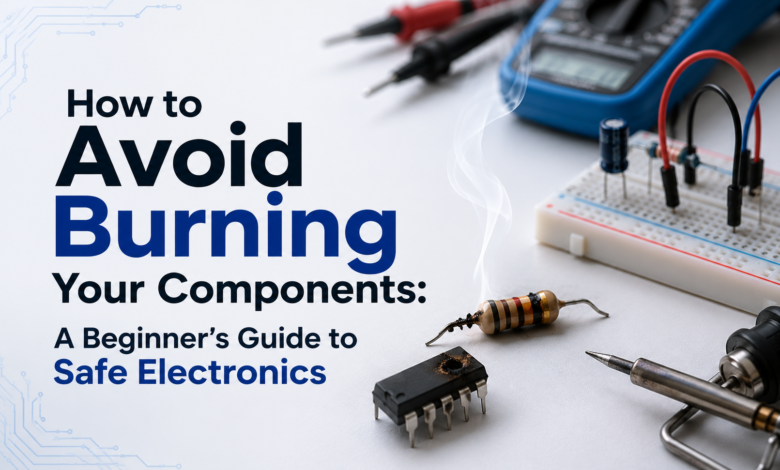
Almost every electronics hobbyist has a story about the first time they let the magic smoke out of a component. Burning out a part is one of the most common beginner mistakes, and usually it comes down to a handful of predictable causes — not bad luck. This guide walks through the most frequent reasons components fail, and simple habits that will save your parts (and your budget) on future builds.
Why Components Burn Out :
Every electronic component has limits on how much voltage, current, or heat it can handle before it’s permanently damaged. Exceeding those limits — even briefly — can cause a part to overheat, melt internally, or fail outright. Most burnouts happen because a beginner skipped a calculation, misread a datasheet, or wired something backward, not because the component itself was faulty.
Common Causes of Burned Components :
- No current-limiting resistor
LEDs are the most common victim here. Without a resistor to limit current, an LED will draw far more than it can handle and burn out almost instantly, even on a simple 5V supply.
- Reversed polarity
Diodes, LEDs, electrolytic capacitors, and many ICs only work in one direction. Wiring them backward can cause immediate failure, and in the case of some capacitors, it can even cause them to rupture.
- Exceeding voltage ratings
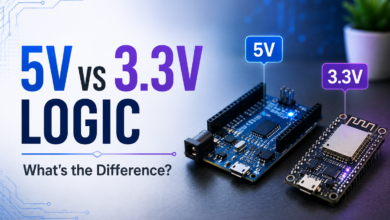
Every component has a maximum voltage it can handle, listed in its datasheet. Feeding a 3.3V sensor with 5V, for example, is a fast way to damage it permanently.
- Incorrect current draw
Motors, LEDs, and other current-hungry components can pull more current than a power source or a connected pin is rated for, overheating both the component and whatever is supplying the power.
- Short circuits
An accidental connection between power and ground, often from a stray wire or a solder bridge, allows current to flow far higher than any component can safely handle, and can happen in a fraction of a second.
- Poor heat dissipation
Components like voltage regulators and power transistors generate heat as part of normal operation. Without adequate heat sinking or airflow, that heat builds up and can cause failure even under otherwise normal conditions.
How to Prevent Burning Components :
- Always calculate resistor values before connecting an LED — a simple Ohm’s Law calculation using the LED’s forward voltage and desired current is all it takes.
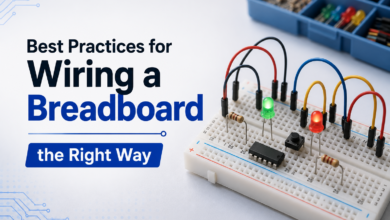
- Double-check polarity on diodes, LEDs, and capacitors before powering on, especially on a breadboard where it’s easy to misplace a leg.
- Match voltage to the component’s rating, not just to what’s convenient — check the datasheet’s recommended operating conditions, not just what you have on hand.
- Use a multimeter to check for shorts before applying power, especially after wiring a new or complex circuit.
- Add heat sinks or ventilation for components that run warm during normal use, like voltage regulators or motor drivers.
- Power on slowly — using a current-limited bench power supply, if you have one, lets you catch a problem before it becomes a burnt component.
Tips for Beginners :
- When in doubt, look up the datasheet — the recommended operating conditions section tells you exactly what a part can safely handle.
- Build the habit of double-checking your wiring against a diagram before applying power, not after something starts smoking.
- Keep spare resistors and common components on hand — mistakes happen even with good habits, and a spare part means a five-minute fix instead of a scrapped project.
- If a component gets noticeably hot to the touch during normal operation, that’s a sign something is drawing too much current or is undersized for the job.
Frequently Asked Questions :
- How do I know if I need a resistor?
Any component with a specific forward voltage lower than your supply voltage — like an LED — needs a current-limiting resistor unless the datasheet says otherwise.
- Can a burned component be fixed?
Almost never. Once a component has been damaged by excess voltage, current, or heat, it typically needs to be replaced rather than repaired.
- What’s the fastest way to catch a wiring mistake before it causes damage?
Use a multimeter to check for continuity or shorts between power and ground before turning on your circuit — it takes seconds and catches most dangerous mistakes.
Burning a component isn’t a rite of passage you have to accept — it’s almost always preventable with a few simple habits: checking your math, checking your polarity, and checking your wiring before power ever gets applied.
Visit tinkercircuits.com for more beginner-friendly Arduino and ESP32 guides.
Happy Tinkering! — The Tinker Circuits Team.