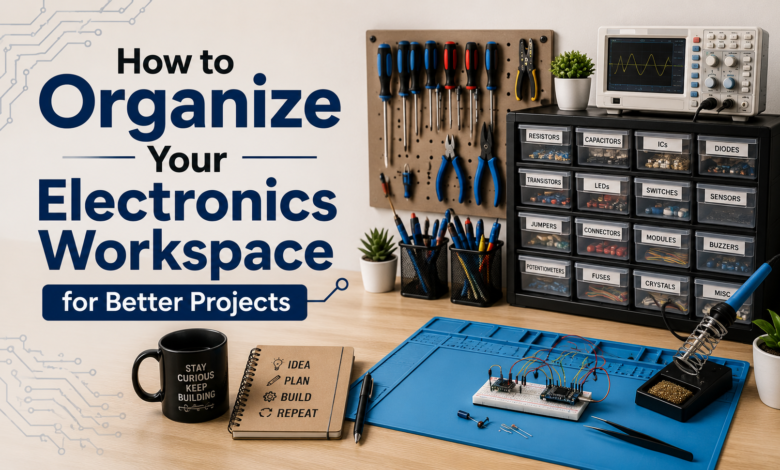
A cluttered workbench slows down every project. Learn practical tips to organise your electronics workspace — tools, components, and cables — for faster, easier builds.
How to Organise Your Electronics Workspace :
A messy workbench doesn’t just look bad — it actively slows you down. Hunting for a missing resistor value, untangling wires, or losing track of which jumper wire goes where can turn a quick project into an hour of frustration. A well-organised electronics workspace saves time on every single build, and it doesn’t take much effort to set up once you know what to prioritise.
Why Workspace Organisation Matters :
Electronics projects involve a lot of small parts — resistors, capacitors, jumper wires, screws, and tools — that are easy to lose track of. An organized space means less time searching and more time actually building. It also reduces mistakes: a clear, well-lit desk makes it far easier to spot a wiring error or a misplaced component before it becomes a problem.
Key Areas to Organise :
- Component storage
Small parts bins or a divided storage box are essential. Sort components by type (resistors, capacitors, ICs) and, where practical, by value. Labelling drawers or compartments saves far more time than it costs to set up.
- Tool organisation
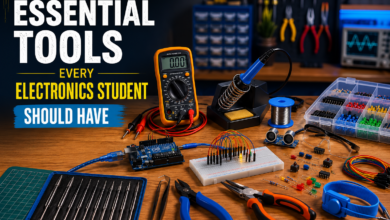
Keep your most-used tools — wire strippers, screwdrivers, multimeter, soldering iron — within arm’s reach in a dedicated spot, like a tool stand or a pegboard. Tools that are constantly picked up and put down should never be buried in a drawer.
- Workbench surface
A dedicated, clutter-free surface for active builds keeps a project contained instead of spreading across your whole desk. An anti-static mat is a worthwhile addition if you’re handling sensitive ICs or microcontrollers.
- Cable and wire management
Loose jumper wires and cables tend to become a tangled mess fast. Small bins, cable ties, or a simple wire organiser keep them sorted by length or type, so you’re not digging through a knot every time you need one.
- Lighting
Good, focused lighting — like an adjustable desk lamp or a ring light — makes it much easier to read tiny component markings, follow thin traces, and solder accurately.
- Safety and ventilation
If you solder regularly, a small fume extractor or working near a window/vent matters more than people expect. Keep a fire-resistant mat under your soldering iron, and store batteries away from metal tools and other batteries.
A Simple Workspace Setup for Beginners :
- A multi-drawer parts organizer for resistors, capacitors, and small ICs
- A pegboard or tool stand for frequently used tools
- A dedicated anti-static work mat for active builds
- A small bin or wire spool holder for jumper wires and cables
- An adjustable lamp positioned to avoid shadows over your work area
- A basic fire-safe mat and stand for your soldering iron
Tips for Keeping It Organised Long-Term :
- Do a five-minute reset at the end of every session — put parts back before you stop, not the next time you sit down.
- Keep a small “in-progress” tray for whatever project you’re actively working on, separate from your main storage, so a build-in-progress doesn’t spread across your whole desk.
- Label everything, even if it feels excessive at first — future you will thank present you when hunting for a specific resistor value.
- Periodically sort through miscellaneous parts bins; loose components tend to accumulate faster than they get used.
Frequently Asked Questions :
- Do I need an anti-static mat for hobby projects?
It’s not strictly required for simple projects like LEDs or basic sensors, but it becomes valuable once you’re regularly handling microcontrollers or sensitive ICs, where static discharge can cause silent damage.
- What’s the most important thing to organise first?
Component storage. A sorted, labeled parts bin has the biggest immediate impact on how quickly you can start and finish a project.
- How much space do I actually need for an electronics workspace?
Not much — a single desk with a dedicated work mat, nearby parts storage, and good lighting is enough for most hobbyist projects. Organisation matters far more than square footage.
An organized workspace isn’t about having a fancy setup — it’s about knowing where everything is before you need it. A little structure up front, in your components, tools, and workspace, pays off in every project you build afterward.
Visit tinkercircuits.com for more beginner-friendly Arduino and ESP32 guides.
Happy Tinkering! — The Tinker Circuits Team.