Not sure whether to pick an ESP32 or an ESP8266 for your next project? This beginner-friendly comparison breaks down the key differences to help you choose the right board.
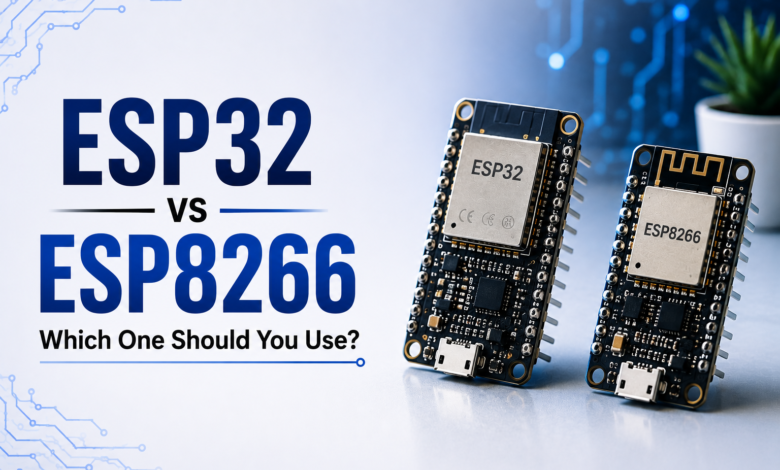
ESP32 vs ESP8266 — Which One Should You Use?
The ESP32 and ESP8266 are two of the most popular microcontrollers for Wi-Fi connected projects, and it’s easy to assume the newer, more powerful ESP32 is always the right pick. In reality, the “best” choice depends on what you’re building. This guide breaks down the real differences between the two, so you can pick the right board instead of just the newer one.
What Is the ESP8266?
The ESP8266 is a low-cost, single-core microcontroller with built-in Wi-Fi. It became popular as one of the first affordable ways to add internet connectivity to a hobby project, and it’s still widely used today for simple, lightweight tasks like sending sensor readings to a server or controlling a device over Wi-Fi.
What Is the ESP32?
The ESP32 is the more capable successor to the ESP8266, adding a dual-core processor, Bluetooth alongside Wi-Fi, more GPIO pins, and additional features like touch-sensitive pins and built-in hardware for tasks like analog-to-digital conversion. It’s designed to handle more demanding projects without needing extra supporting hardware.
Key Differences Between ESP32 and ESP8266 :
| Feature | ESP8266 | ESP32 |
|---|---|---|
| Processor | Single-core | Dual-core |
| Wireless | Wi-Fi only | Wi-Fi + Bluetooth |
| GPIO pins | Fewer usable pins | Significantly more |
| ADC channels | Limited (1 usable) | Multiple |
| Price | Lower | Slightly higher |
| Power consumption | Lower for simple tasks | Higher, but more efficient sleep modes |
| Best for | Simple, single-purpose Wi-Fi projects | Multi-tasking, Bluetooth, or pin-heavy projects |
When to Choose the ESP8266 :
- Your project is simple and only needs Wi-Fi, not Bluetooth
- You’re working with a tight budget across multiple units
- The project doesn’t need many GPIO pins or analog inputs
- You’re building something like a basic Wi-Fi sensor node or a simple smart switch
When to Choose the ESP32 :
- Your project needs Bluetooth in addition to Wi-Fi
- You need more GPIO pins, multiple analog inputs, or advanced peripherals
- The project involves multitasking, like handling Wi-Fi communication and sensor readings simultaneously
- You’re building something more complex, like a multi-sensor hub, a camera-based project, or a Bluetooth-and-Wi-Fi combo device
A Practical Example :
If you’re building a simple temperature sensor that reports readings to a Wi-Fi dashboard every few minutes, an ESP8266 handles that easily and keeps costs down. But if you’re building a project that also needs to pair with a phone over Bluetooth, read from several analog sensors at once, or run more complex logic in parallel, the ESP32’s extra pins and dual-core processor make it the better fit.
Tips for Beginners :
- Don’t default to the ESP32 just because it’s newer — for very simple projects, the ESP8266 is cheaper and still fully capable.
- Check your project’s analog input needs early. The ESP8266’s single usable ADC pin is a common bottleneck that pushes projects toward the ESP32.
- If you’re unsure whether a future version of your project might need Bluetooth or more pins, it’s often worth starting with an ESP32 to avoid a board swap later.
Frequently Asked Questions :
- Can I run the same code on both boards?
Mostly, but not always. Both use similar Arduino-style programming, but pin numbers, some libraries, and hardware-specific features differ, so code often needs small adjustments when moving between the two.
- Is the ESP32 always the better choice?
Not necessarily. For very simple, single-purpose Wi-Fi projects, the ESP8266 is cheaper and still gets the job done without unused capability.
- Does the ESP32 use more power than the ESP8266?
It can draw more power during active use due to its dual-core processor and Bluetooth radio, but it also offers more refined sleep modes, which can make it more efficient in battery-powered projects with the right configuration.
Choosing between the ESP32 and ESP8266 comes down to matching the board to your project’s real requirements, not just picking whichever one sounds more powerful. For simple Wi-Fi tasks, the ESP8266 remains a solid, budget-friendly choice, while the ESP32’s extra pins, Bluetooth, and processing power make it the better fit for more complex builds.
Visit tinkercircuits.com for more beginner-friendly Arduino and ESP32 guides.
Happy Tinkering! — The Tinker Circuits Team.